Posts

Showing posts with the label Research

Research from the Lab's Little AI Scholars: Learn the life language using artificial intelligence
Image
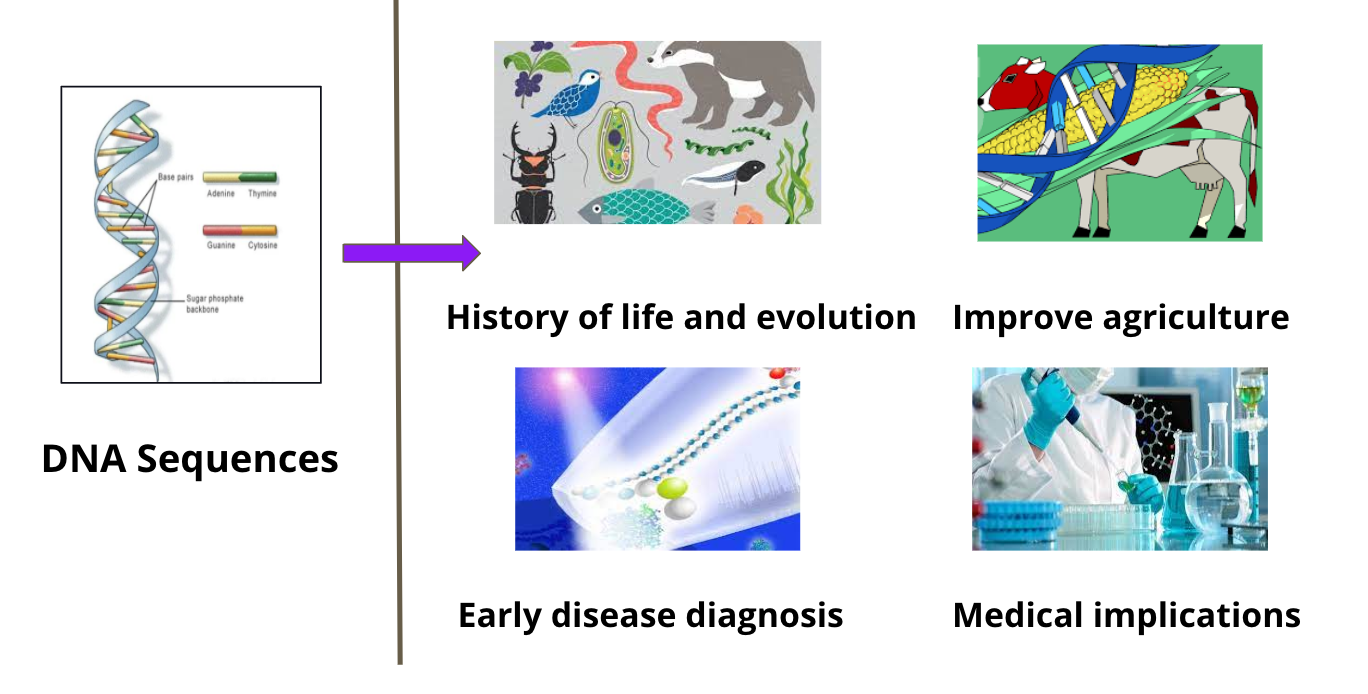
1. Background 1.1 project/research background This project explores the applications of Artificial intelligence (AI) techniques for classifying Deoxyribonucleic Acid (DNA) sequences by three high school students under teaching and supervision in the Lab's Little AI Scholars program. To explain AI information and concepts understandably, a couple of analogies were introduced during the research. They were displayed using interesting images to give the high school students a better understanding, and we have successfully achieved our goal of Auto Recognition of DNA Sequences. We first transformed the DNA sequences into human-like language. Then we employed Natural Language Processing (NLP) and Multi-layer perceptron (MLP) to complete sequence classification into 7 gene families from 3 organisms (humans, dogs, and chimpanzees). During this exciting research, the high school students deeply understood the biological and mathematical knowledge they learned in class and adapted them to t...

AI in news: AI is used to save lives with sepsis.

 It is great to hear that AI is used to save people who get infection with sepsis!  “It is the first instance where AI is implemented at the bedside, used by thousands of providers, and where we’re seeing lives saved,” says Suchi Saria, founding research director of the Malone Center for Engineering in Healthcare at Johns Hopkins University, and lead author of the studies, which evaluated more than a half million patients over two years. News link.  

Lab's recommendation: Some Notebooks for NLP Beginner

 Today I will not post the specific tech note about Python. While I will put some awesome notebooks collected before on Kaggle for the beginner to learn NLP. Enjoy! 😀 Approaching (Almost) Any NLP Problem on Kaggle All In One NLP 80% with vector embedding+ feature engineering

Lab's opion about AI Ethics: Thinking about GPT-3's Powerful Text Generation

 It could be a must-think about AI ethics now. Some AI models, such as GPT-3, can generate text in its powerful ability even an academic paper about itself.  News link:  We Asked GPT-3 to Write an Academic Paper about Itself—Then We Tried to Get It Published

Lab's Research: Semi-Supervised Semantic Segmentation for Vessel Images using Leaking Perturbations

Image
Abstract: Semantic segmentation based on deep learning methods can attain appealing accuracy provided large amounts of annotated samples. However, it remains a challenging task when only limited labelled data are available, which is especially common in medical imaging. In this paper, we propose to use Leaking GAN, a GAN-based semi-supervised architecture for retina vessel semantic segmentation. Our key idea is to pollute the discriminator by leaking information from the generator. This leads to more moderate generations that benefit the training of GAN. As a result, the unlabelled examples can be better utilized to boost the learning of the discriminator, which eventually leads to stronger classification performance. In addition, to overcome the variations in medical images, the mean-teacher mechanism is utilized as an auxiliary regularization of the discriminator. Further, we modify the focal loss to fit it as the consistency objective for mean-teacher regularizer. Extensive expe...

Lab's Research: Cross-Domain Latent Modulation for Variational Transfer Learning

Image
Abstract: To successfully apply trained neural network models to new domains, powerful transfer learning solutions are essential. We propose to introduce a novel cross-domain latent modulation mechanism to a variational autoencoder framework so as to achieve effective transfer learning. Our key idea is to procure deep representations from one data domain and use it to influence the reparameterization of the latent variable of another domain. Specifically, deep representations of the source and target domains are first extracted by a unified inference model and aligned by employing gradient reversal. The learned deep representations are then cross-modulated to the latent encoding of the alternative domain, where consistency constraints are also applied. In the empirical validation that includes a number of transfer learning benchmark tasks for unsupervised domain adaptation and image-to-image translation, our model demonstrates competitive performance, which is also supported by evidenc...

Lab's Research: Deep Adversarial Transition Learning using Cross-Grafted Generative Stacks

  Abstract: As a common approach of deep domain adaptation in computer vision, current works have mainly focused on learning domain-invariant features from different domains, achieving limited success in transfer learning. In this paper, we present a novel ``deep adversarial transition learning'' (DATL) framework that bridges the domain gap by generating some intermediate, transitional spaces between the source and target domains through the employment of adjustable, cross-grafted generative network stacks and effective adversarial learning between transitions. Specifically, variational auto-encoders (VAEs) are constructed for the domains, and bidirectional transitions are formed by cross-grafting the VAEs' decoder stacks. Generative adversarial networks are then employed to map the target domain data to the label space of the source domain, which is achieved by aligning the transitions initiated by different domains. This results in a new, effective learning paradigm, wher...

Lab's Research: Unsupervised Domain Adaptation using Deep Networks with Cross-Grafted Stacks

Image
Abstract: Current deep domain adaptation methods used in computer vision have mainly focused on learning discriminative and domain-invariant features across different domains. In this paper, we present a novel approach that bridges the domain gap by projecting the source and target domains into a common association space through an unsupervised ``cross-grafted representation stacking'' (CGRS) mechanism. Specifically, we construct variational auto-encoders (VAE) for the two domains, and form bidirectional associations by cross-grafting the VAEs' decoder stacks. Furthermore, generative adversarial networks (GAN) are employed for domain adaptation (DA), mapping the target domain data to the known label space of the source domain. The overall adaptation process hence consists of three phases: feature representation learning by VAEs, association generation, and association alignment by GANs. Experimental results demonstrate that our CGRS-DA approach outperforms the state-of-the-...

Writing using Latex: remove the first page number in Latex

 Sometimes, you may want to leave the first page number to empty. Then you can use \thispagestyle{empty}, put it after \maketitlet The link is  remove page number of first page