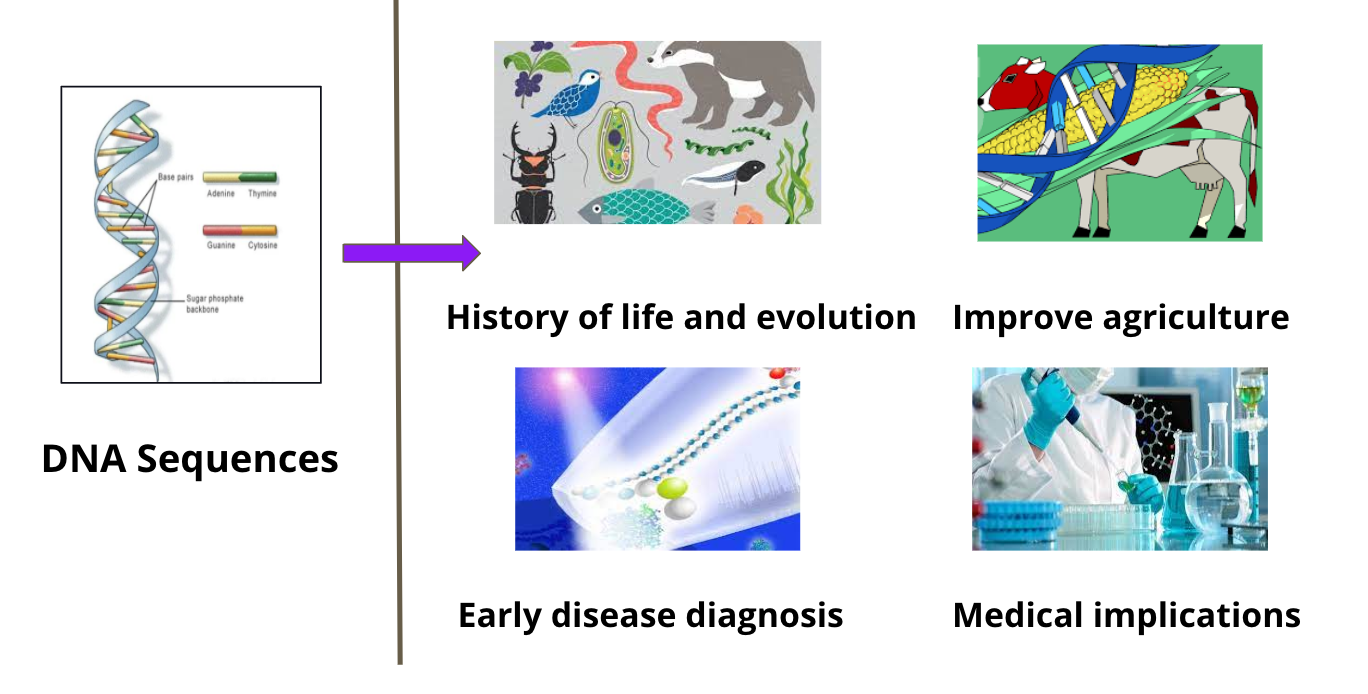
1. Background 1.1 project/research background This project explores the applications of Artificial intelligence (AI) techniques for classifying Deoxyribonucleic Acid (DNA) sequences by three high school students under teaching and supervision in the Lab's Little AI Scholars program. To explain AI information and concepts understandably, a couple of analogies were introduced during the research. They were displayed using interesting images to give the high school students a better understanding, and we have successfully achieved our goal of Auto Recognition of DNA Sequences. We first transformed the DNA sequences into human-like language. Then we employed Natural Language Processing (NLP) and Multi-layer perceptron (MLP) to complete sequence classification into 7 gene families from 3 organisms (humans, dogs, and chimpanzees). During this exciting research, the high school students deeply understood the biological and mathematical knowledge they learned in class and adapted them to t...
Machine Learning in Action (MLiA) This is an old book, which was published ten years ago, in 2012. The author is Peter Harrington. At that time, there is not so popular ML tools like scikit learn or the DL framework like TF, and Pytorch. This book describes the ML concept and the necessary formula to understand the learning algorithms. Most importantly, the author gives the implementation bit by bit (not just call API) for the algorithms. These can get the reader a deep understanding of how the models/algorithms work and are built. It's super helpful! This book is good for beginner or intermediate readers. But please forget that the top 10 models in ML as the book says, actually there is no best one but just a suitable one. Also, there is a GitHub repo for the code (though I think could dirt your hands following the book and get the best learning). The code is in python 2, a popular version a decade ago (currently has stopped the support to python 2). I do not te...
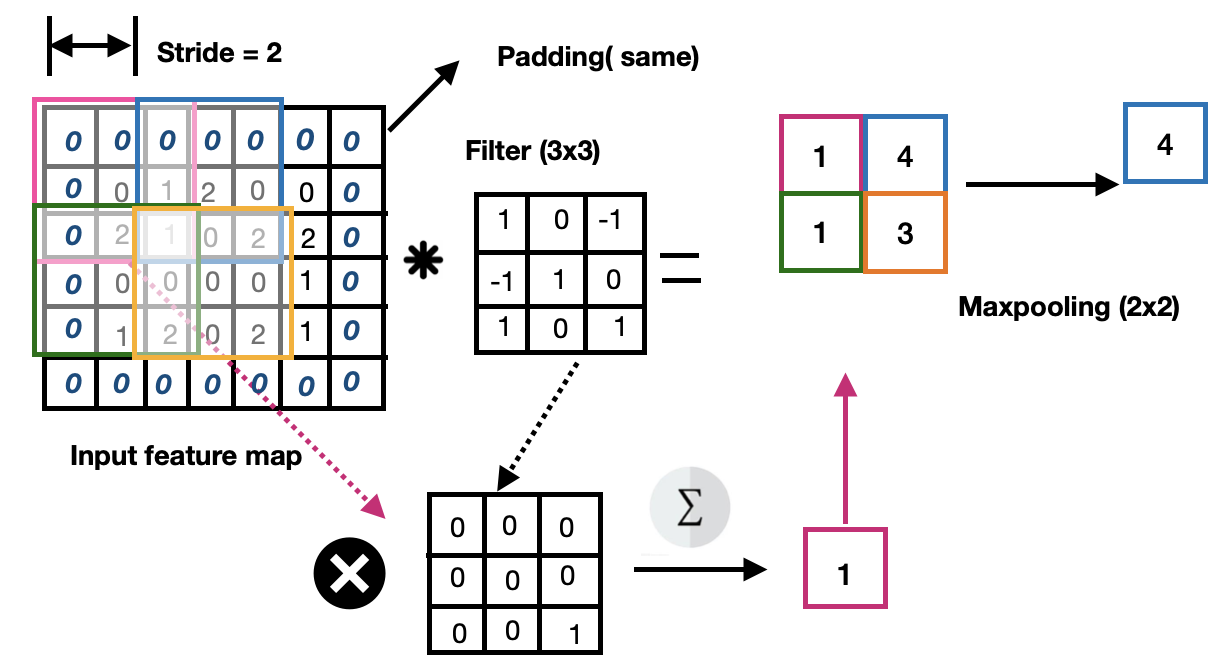
In U-Net the encoder block comprises two components: 2D convolution and max-pooling operations. The 2D convolution is a technique in image processing that generates a feature map. While max-pooling can reduce the size/shape of the feature map. The 2D convolution equation is as follows: \begin{equation} \mathbf{F}(m, n) = \sum_j\sum_k \mathbf{K}(i, j)\mathbf{I}(m-i)(n-j) \end{equation} Where 𝑲 is the kernel or filter, pass it over the image 𝑰. The indexes of rows and columns of the results feature map are marked with m and n respectively. In Figure 1, we show what are the operations in the encoder block, including 2D convolution, max pooling and related technologies. Figure 1. Operations in the encoder block In Figure 1, we add a layer with the number “0” called padding, which is used to maintain the size of the original input. Then the filter K shaped as a 3 by 3 matrix performs an element-wise multiplication with the input image 𝑰. The values are summed to ...

Comments
Post a Comment